
We are a small team of people specializing in neuro-affirmative and therapeutic assessment and progressive intervention recommendations.
The concerned person will be assessed by our trained assessor(s) using a set of tools including interviews, questionnaires, rating scales, observations and tests customized for you or your family member’s individual needs and questions. This is a detailed and specialized process that can take up to 2 months from the initial appointment setting to receiving the report.
The steps involved in the assessment process are:
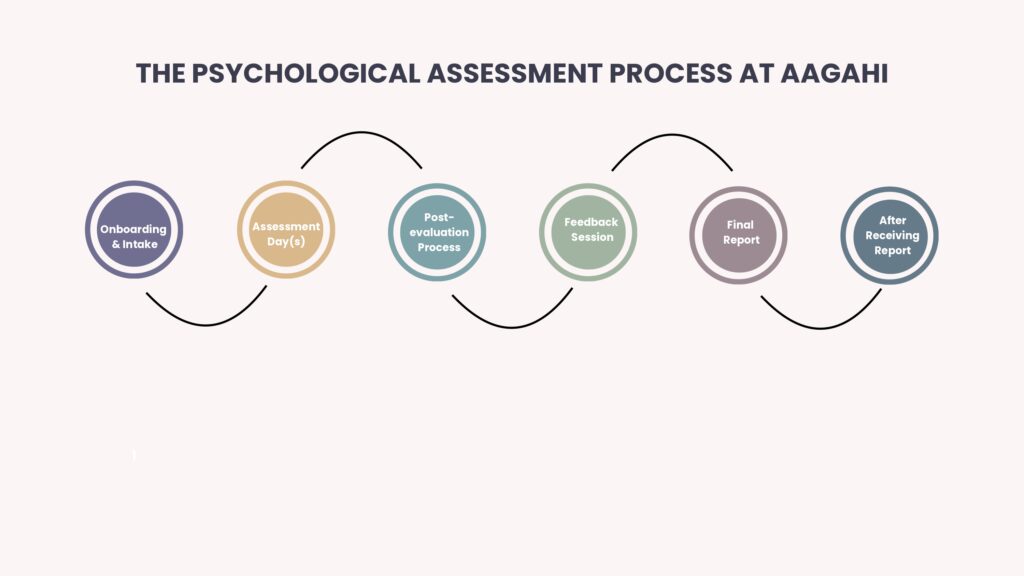
Step 1: Onboarding & Intake
-
- A virtual intake session is scheduled with a psychologist. (If the client is a child, the parents’ session is additional.)
- During this session, your questions and concerns will be reviewed and answered.
- Intake and consent forms are completed.
- Upload of previous evaluations or helpful records is done.
- An initial deposit collected, and the approximate cost of the evaluation is assessed.
Step 2: Assessment Day(s) – In person in a warm, safe, welcoming setting in Whitefield, Bangalore
-
- The testing generally takes place in one visit unless there are valid reasons to break the evaluation into parts using shorter sessions over 2-3 days.
- Depending on the evaluation type, sessions can last 3-4 hours with breaks.
- You are encouraged to dress comfortably and bring snacks and hydration.
Step 3: Post-evaluation Process
-
- Digital rating scales are sent to parents, partners, educators, or other pertinent collateral contacts with a Release of Information form signed the week after testing.
- Any needed follow-up information or data collection is scheduled.
- The psychologist spends between 5-8 hours scoring and synthesizing data.
Step 4: Feedback Session
-
- Between 2-3 weeks after testing, you will meet with the psychologist virtually to review initial findings of the evaluation.
- The appointment is generally 1 hour.
- A priority action plan and recommendations will be reviewed.
- 50% of the total cost of the evaluation is collected.
Step 5: Final Report
-
- The final report is based on information from the feedback session and report finalization process.
- There is a final collection attempt of any digital rating scales.
- You will receive a comprehensive written report within 3 weeks of the feedback meeting after payment of the remaining 50%, minus the initial deposit.
Step 6: After Receiving Report
-
- After reviewing the report, you may reach out with other questions or to further discuss findings and action items.
- Up to 30 minutes of a follow-up session can be done without additional charges.
- An additional letter to school or a specific professional body can be requested at additional cost and with proper Release of Information forms signed.
Validity of assessments in India - RPwD act
The RPwD Act 2016 explains how disability should be officially checked and certified in India for conditions like intellectual disability, specific learning disability, mental illness and other brain-related conditions. It clearly states who is allowed to assess these conditions, such as paediatricians, psychiatrists and clinical or rehabilitation psychologists working together as a medical board led by a government-appointed authority, so that assessments are team-based and uniform across the country.
For intellectual disability, a child can receive a formal disability certificate after completing 1 year of age. Children younger than 5 are usually described as having “Global Developmental Delay”, and this may be changed to “Intellectual Disability” after age 5. Certificates given before age 5 are temporary and usually valid for up to 3 years or until the child turns 5. After 5 years, certificates are renewed at ages 5, 10 and 18, and the certificate given at 18 years is generally valid for life.
For Specific Learning Disability (SLD), schools are expected to start screening children around 8 years of age, usually in Class 3. Formal government certification is only given from age 8 onwards. Children with SLD must be re-certified at 14 and again at 18 years, and once the 18-year certificate is issued, it usually remains valid for life.
For mental illnesses and long-term neurological problems, the law requires a careful clinical assessment using standard disability scales. The medical board that decides on the certificate must include at least a psychiatrist and a trained psychologist. These assessments decide whether the person will be officially recognised as a “person with disability” and therefore eligible for supports like accommodations, benefits and services. If the condition can change or get worse, the law allows for the person to be reassessed over time.
Only government-recognised “medical authorities” such as certain government hospitals or medical colleges are allowed to issue the legal disability certificate needed for reservations, benefits and official accommodations across India. State governments set up these medical boards-for example, Victoria Hospital, NIMHANS and other designated hospitals in Karnataka-and they must follow central guidelines under the RPwD Act.
Reports from private psychologists, therapists, special educators or schools can help understand the child’s or adult’s needs and are important for planning support, but by themselves they do not count as an official disability certificate. Families usually take these private reports, along with all other documents, to a notified medical board. The board looks at the history, may repeat or add assessments, and then decides whether to issue a disability certificate and what percentage of disability to record. In Bengaluru, centres like NIMHANS act as official medical boards for conditions such as intellectual disability, autism and mental illness, and many families are sent there by schools or NGOs like Snehadhara or the Spastics Society when a government-recognised certificate is required.
State rules, such as the Karnataka RPwD Rules 2019, and older government orders list which hospitals can run these boards and make it clear that a disability certificate issued under the RPwD Act is valid all over India. These rules also set timelines for issuing certificates, usually within 30 days of applying, and describe when and how a person should be reassessed if their disability can change over time. In practice, the process usually starts with preliminary assessments in clinics, hospitals, or educational settings, after which the case is sent to a recognised medical authority for the official certificate.
If you would like to book an assessment, please write to us: